Solar energy is an option for businesses, commercial buildings, agricultural operations, and other facilities looking to generate electricity from sunlight. However, a successful solar installation involves much more than placing panels on a roof or mounting them on the ground.
A solar power system must be designed around the energy requirements of the site, the characteristics of the available installation area, the equipment being powered, and the level of reliability required. In some applications, battery storage or another power source may also be necessary.
For organizations considering solar installation in Ethiopia, understanding the planning process can help clarify equipment requirements, project costs, operating expectations, and maintenance needs.
Zamra Electromechanical PLC focuses on solar energy solutions and related electromechanical services, helping customers explore system requirements and suitable equipment for their applications.
1. Begin With an Energy Assessment
The first step in a solar project is understanding how much electricity the facility uses and when it needs that electricity.
A useful assessment examines electricity bills where available, equipment ratings, daily operating schedules, and periods of high demand. It should also identify which loads are essential and which can be operated at different times.
For example, an office may have daytime lighting, computers, cooling equipment, and communication systems. A workshop may use electric motors, tools, compressors, and other equipment with different power demands. A farm may operate pumps according to irrigation requirements.
These applications cannot all be served by the same system design.
An energy assessment should establish:
- The total electricity consumption over a representative period.
- The maximum simultaneous power demand.
- The daily operating hours of major equipment.
- The equipment that must remain powered during an outage.
- Potential future increases in electricity demand.
- Any restrictions affecting the installation site.
Accurate information at this stage helps prevent the system from being designed around assumptions that do not reflect actual usage.
2. Understand the Difference Between Power and Energy
Two important concepts in solar system planning are power and energy.
Power, usually measured in watts or kilowatts, describes the rate at which equipment consumes or supplies electricity at a given moment. Energy, commonly measured in kilowatt-hours (kWh), represents the amount of electricity consumed or generated over time.
For example, a 2 kW appliance operating continuously for three hours uses 6 kWh of energy, assuming it draws its rated power throughout that period.
This distinction matters because solar panels, inverters, batteries, and electrical loads have different ratings and operating characteristics.
The system must be able to provide sufficient instantaneous power for the loads being operated while also generating or storing enough energy to meet the required consumption pattern.
Motor-driven equipment may also require additional starting power, depending on the motor and its starting method. This should be considered during system sizing.
3. Choose the Appropriate Solar System Type
Solar installations generally fall into three broad categories. The right choice depends on grid availability, reliability requirements, budget, and operating conditions.
Grid-connected solar systems
A grid-connected system works alongside the electricity grid. Solar panels generate electricity that can supply compatible loads, reducing the amount of electricity needed from the grid when solar production is available.
The system requires suitable inverter technology and must comply with applicable interconnection and safety requirements. Whether surplus electricity can be exported, and under what conditions, depends on local arrangements and regulations.
Grid-connected systems may suit commercial buildings, offices, and facilities that have a reliable grid connection and significant daytime electricity use.
Off-grid solar systems
An off-grid system operates without relying on a utility grid connection. It may use solar panels, batteries, charge controllers, inverters, and other equipment selected to meet the site’s requirements.
System design must account for periods of low solar production, energy storage, essential loads, and the availability of backup generation if required.
Off-grid installations can be relevant to remote facilities, agricultural operations, and locations where grid access is unavailable or impractical.
Hybrid solar systems
A hybrid system combines solar generation with battery storage and may also work with the grid or a compatible backup generator.
The configuration can help manage energy use and maintain selected loads when solar production is insufficient, provided the system has been designed for that purpose.
The presence of batteries alone does not guarantee uninterrupted power. Battery capacity, inverter capability, load priorities, and control settings all affect the level of backup available.
4. Calculate the Solar Panel Requirements
Solar panels convert sunlight into electrical energy. The number and capacity of panels required depend on expected energy consumption, available sunlight, installation orientation, shading, system losses, and the operating schedule.
The rated capacity of a solar array is typically expressed in kilowatts-peak (kWp). This rating represents the combined nominal output of the panels under specified test conditions; actual production varies with environmental and operating conditions.
A proper design should consider:
- Available solar irradiation at the installation site.
- Panel orientation and tilt.
- Shading from nearby buildings, trees, or structures.
- Temperature and ventilation conditions.
- Cable and conversion losses.
- Seasonal changes in solar production.
- Space available for mounting equipment.
Simply adding up the wattage of the appliances is not enough to determine the required solar array. The design must also consider how long the appliances operate and when that energy is needed.
A site assessment and realistic production estimate can help establish a more appropriate system size.
5. Select a Compatible Inverter
The inverter converts direct-current electricity from the solar array or batteries into alternating-current electricity suitable for compatible loads.
Inverter selection involves more than choosing a capacity that matches the solar panels. The design should consider continuous output power, surge capacity, output voltage, frequency, phase configuration, efficiency, protection features, and compatibility with the chosen battery system where applicable.
Facilities using electric motors, pumps, refrigeration equipment, or other demanding loads should pay particular attention to starting current and load characteristics.
A system with an undersized inverter may fail to operate certain equipment reliably. An incompatible inverter and battery combination can also affect system performance and protection.
Equipment specifications should be checked before purchase and installation.
6. Decide Whether Battery Storage Is Necessary
Battery storage can store energy for later use. It may be used to supply selected loads after sunset, provide backup during grid interruptions, or help manage differences between solar generation and electricity demand.
Battery capacity is commonly expressed in kilowatt-hours, while power output is measured in kilowatts. These are different characteristics: a battery may store a certain amount of energy but still have limits on how quickly that energy can be delivered.
Battery planning should account for:
- The loads that must be supported.
- The required backup duration.
- The usable battery capacity.
- Charging and discharging limits.
- Battery chemistry and operating conditions.
- Inverter compatibility.
- Ventilation, protection, and installation requirements.
- Future replacement and maintenance considerations.
For a facility that needs backup power, it is often more practical to identify essential loads first rather than attempting to supply every appliance during an outage.
The final configuration should be based on the required level of service and a realistic assessment of cost and performance.
7. Plan the Installation and Electrical Protection
Physical installation and electrical integration are critical parts of a solar project.
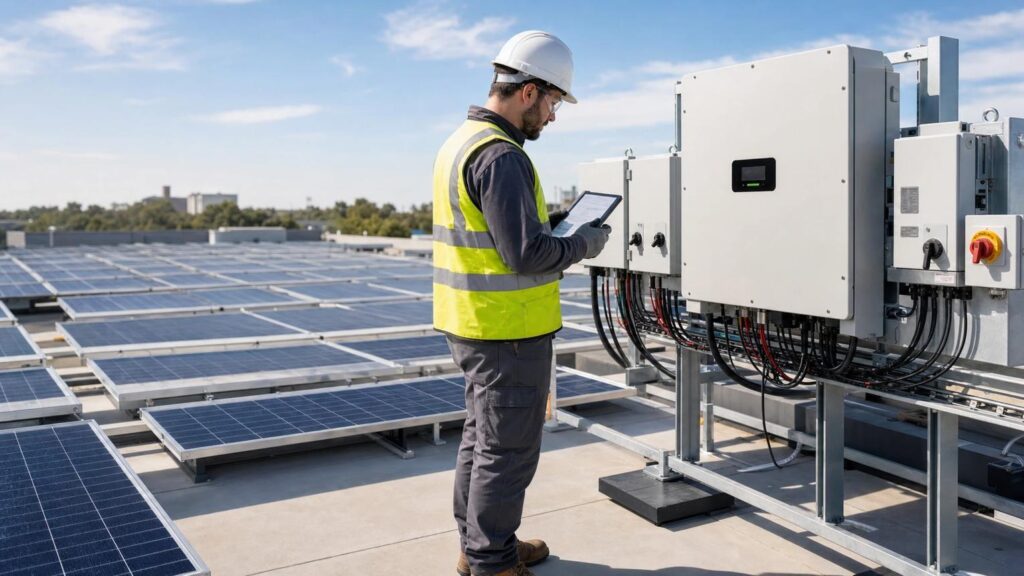
Panels require suitable mounting structures designed for the site conditions. Roof installations must account for roof condition, load capacity, weather exposure, and safe access. Ground-mounted systems require appropriate foundations, layout, and protection against environmental conditions.
The electrical design must also address cable sizing, isolators, circuit protection, grounding or earthing, surge protection where appropriate, and safe separation of system components.
Installation planning should consider:
- Structural suitability of the mounting location.
- Secure and weather-appropriate cable routing.
- Correct string configuration and electrical ratings.
- DC and AC isolation requirements.
- Overcurrent and surge protection where required.
- Grounding and bonding.
- Access for inspection and maintenance.
- Compliance with applicable electrical and building requirements.
These tasks should be undertaken by appropriately qualified personnel using equipment and methods suitable for the installation.
8. Testing and Commissioning
Commissioning verifies that the installed system has been configured correctly and operates as intended.
The specific checks depend on the system type and equipment. They may include inspecting mounting and wiring, checking electrical connections and polarity, verifying grounding and protection arrangements, reviewing inverter settings, confirming battery communication where applicable, and testing the system under suitable operating conditions.
Commissioning should also confirm that monitoring functions work where installed and that the customer understands basic system operation.
A proper handover should include relevant equipment documentation, operating instructions, warranty information, and recommended maintenance procedures.
These records can help the owner or maintenance team understand the system and identify issues more efficiently.
9. Maintenance and Long-Term Performance
Solar power systems require periodic inspection and maintenance. The level of attention depends on the equipment, environmental conditions, installation location, and operating profile.
Maintenance may include checking for visible damage, inspecting mounting structures and electrical enclosures, reviewing inverter alarms, monitoring energy production, and cleaning panels when dirt or dust is affecting performance.
Battery systems may require additional monitoring according to the manufacturer’s instructions. Electrical components should be inspected by suitable personnel, and equipment should never be opened or serviced while energized unless the work is performed under appropriate safety procedures.
Keeping installation records and monitoring system performance can help identify unusual changes before they lead to extended downtime.
10. What Affects the Cost of Solar Installation in Ethiopia?
The cost of a solar installation depends on the site’s requirements and the selected equipment. There is no single price that applies to every building, farm, or business.
Factors affecting the project budget include:
- Required solar array capacity.
- Inverter type and rating.
- Battery capacity, if needed.
- Mounting structures and installation complexity.
- Electrical protection and distribution equipment.
- Cable lengths and routing.
- Site preparation and structural requirements.
- Transportation and installation labour.
- Monitoring, maintenance, and backup requirements.
The lowest initial purchase price does not always represent the best long-term value. Buyers should compare technical suitability, expected performance, warranty terms, compatibility, and maintenance needs alongside the upfront cost.
A clear scope of work and a properly itemized quotation make it easier to compare different proposals.
How Zamra Electromechanical PLC Can Help
Planning a solar installation begins with a clear understanding of the site and the purpose of the system. From there, equipment selection, installation requirements, electrical integration, and maintenance planning can be considered as part of the overall solution.
Zamra Electromechanical PLC focuses on solar energy solutions, electrical equipment, backup power considerations, and related electromechanical applications in Ethiopia.
Customers considering solar power can prepare basic information about their facility, electricity consumption, essential equipment, operating schedule, and backup requirements before requesting a consultation.
This information helps establish the project’s needs and supports a more productive discussion about suitable system options.
Conclusion
A successful solar installation depends on good planning, compatible equipment, appropriate electrical protection, professional installation, and ongoing maintenance.
Whether the goal is to offset daytime electricity consumption, support agricultural pumping, or provide backup power for selected loads, the system should be designed around the actual operating requirements of the site.
By understanding the main stages of solar system planning, businesses and property owners can ask better questions, evaluate proposals more effectively, and make more informed decisions.
Contact Zamra Electromechanical PLC
Company: Zamra Electromechanical PLC
Address: 150 metres before Megenagna 22 Roundabout, Addis Ababa, Ethiopia
Phone: +251 98 277 1897
Email: info@zamraelectromechanical.com
Additional email: birhanu@zamraelectromechanical.com
Website: https://zamraelectromechanical.com/
Contact Zamra to discuss solar installation requirements, solar equipment, backup power options, and electromechanical services in Ethiopia.